Applications
Engineered
Materials for
Demanding
Applications
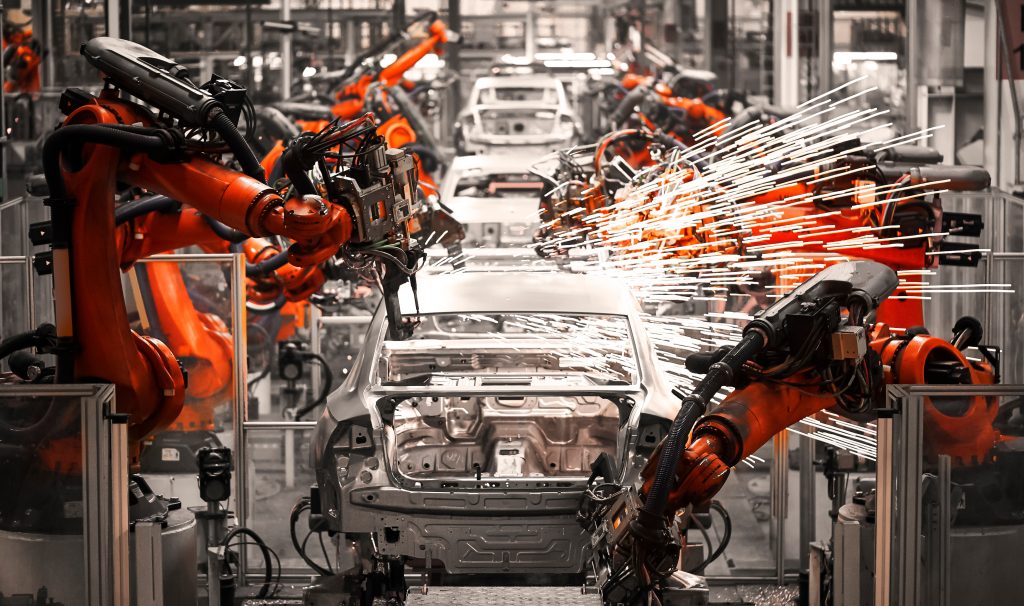
Automotive & EV
Lightweight structural materials for safer, more efficient vehicles
Automotive manufacturers must reduce mass while meeting demanding requirements for crash performance, fatigue life, corrosion resistance, joining, dimensional control, and cost. These priorities are especially important in electric vehicles, where structural efficiency can help offset battery weight and improve vehicle range and performance.
Atomic13 is developing advanced aluminum structural materials designed around application-specific targets for strength-to-weight performance, ductility, fatigue resistance, weldability, surface quality, and manufacturing consistency. Potential applications include battery enclosures, crash-management systems, body and chassis reinforcements, seat and cross-car structures, and other complex extruded components. Atomic13 works with customers from prototype evaluation through program-specific validation and qualification.

Commercial Space
Scalable structural performance for demanding flight and space systems
Launch vehicles, spacecraft, satellites, aircraft, and space robotics require structural materials that deliver high performance with minimal mass while maintaining precision through vibration, fatigue, and thermal cycling. As commercial programs scale, repeatability, production efficiency, and supply availability become increasingly important alongside flight performance.
Atomic13 is developing advanced aluminum structural materials that target strength-to-weight performance, fatigue resistance, dimensional stability, microstructural uniformity, surface quality, and manufacturing consistency. Potential applications include launch structures, satellite frames and rails, spacecraft and aircraft structural members, payload supports, avionics and battery housings, thermal-management structures, and robotic systems. Atomic13 works with customers to define and validate the requirements of each program before deployment.

Humanoid Robotics / Robotics
Lighter, more durable structures for intelligent machines
In mobile robots, every kilogram affects battery life, payload, actuator sizing, balance, and operating efficiency. As humanoid and general-purpose robots move into sustained commercial use, their structures must also withstand repeated dynamic loading while maintaining tight tolerances and reliable alignment across joints, actuators, sensors, and precision assemblies.
Atomic13 is developing structural materials that target low mass, strength, fatigue performance, dimensional stability, surface quality, and repeatable mechanical properties. Potential applications include frames and limbs, joint structures, actuator and gearbox housings, battery enclosures, sensor supports, and end-effectors. By working early with robotics OEMs, Atomic13 can help enable lighter, longer-lasting, and more manufacturable robotic platforms.

Aerospace & Defense
Structural performance, platform mobility, and supply resilience
Defense platforms must reduce mass and increase payload or range while operating through shock, vibration, fatigue, corrosion, and thermal cycling. Manufacturers also need repeatable production and resilient domestic supply chains for critical structural materials.
Atomic13 is developing advanced materials around platform-specific targets for strength-to-weight performance, damage tolerance, fatigue life, corrosion resistance, dimensional stability, joining, and production consistency. A manufacturing model built around domestic post-consumer aluminum can also support a more circular and resilient material supply. Potential applications include tactical vehicles, autonomous systems, aerospace and space structures, protective housings, mobile equipment, and lightweight deployable systems.
