why We’re different
Built like an advanced
materials company
Atomic13 industrializes shear extrusion to engineer microstructure in a way that lets us deliver what conventional presses can’t; edge to core and end to end uniformity in microstructure and thus properties, higher strength with higher elongation together (no trade-off), stable pricing, the lowest carbon footprint in the global industry and customer alloys that outperform standard ASTM chemistries used by the rest of the industry.
Edge to core uniformity
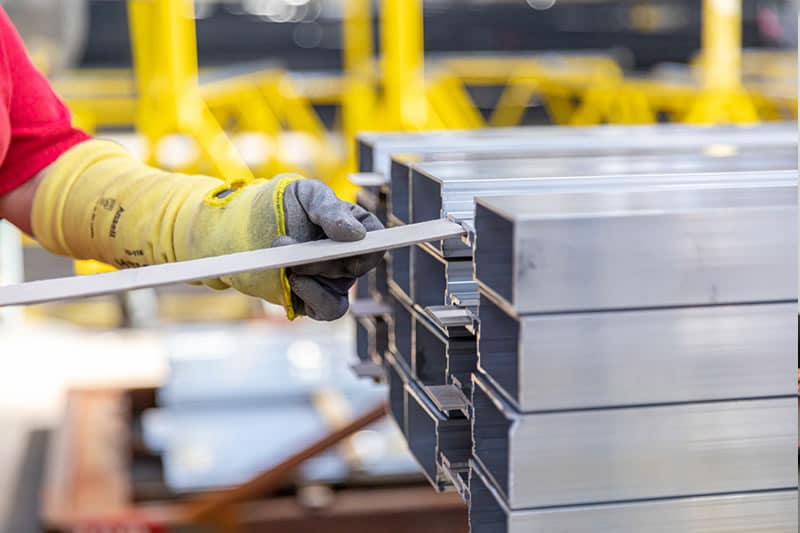
Conventional extrusions inherit cast‑in variability; we completely modify the cast microstructure during shear rendering it benign. Intermetallics are fragmented and redistributed, grains are refined, and texture is controlled—from surface to core.
What this means for you:
- Tighter dimensional tolerances, straighter lengths, predictable spring back, and controlled radii during bending around a mandrel.
- Higher machining yields and more consistent crash management behavior.
- Less directionality to surface finish due to neutralization of casting anomalies creates a better mill surface finish for anodize and paint.
Strength and elongation
Where the industry typically trades ductility to gain strength, our property-first process can raise both since shear can create a fully equiaxed gain size with a weak texture throughout the thickness. This is the recipe for higher yield and tensile strength coupled with stable or increased elongation.
Applications:
- Crash management systems and battery rails with steel‑like strength.
- Additional lightweighting possibilities given the opportunity to increase strength and elongation at thinner cross sections.
- Improved forming without sacrificing product integrity.
Stable pricing, program certainty
We build billets from 100% post‑consumer scrap (PCI + twitch)—no primary aluminum. That decouples cost from LME/Midwest Premium volatility so multi‑year programs can lock in stable, predictable pricing.
Procurement wins:
- LTAs with scrap‑indexed economics (18–36‑month planning).
- Domestic, tariff‑insulated supply; fewer surprise surcharges.
- Better cost forecasting at the BOM level.
CUSTOMER ALLOY FAMILIES THAT OUTPERFORM ASTM SPECIFICATION STANDARDS IN EVERY WAY
While we can produce inside ASTM limitations for chemistry and properties, the potential really unlocks when we work the other way. Start with the customer application and understand exactly how it must perform in service. Define the microstructural characteristics and crystallographic texture that is needed to generate the property characteristics (strength, crush, fatigue, formability) and from there define shear deformation parameters and finally a custom chemistry that is compatible. And all of this costs less than the conventional, ‘pick from a catalog’ process’.
Roadmap highlights:
- A13-6X: High strength, formable 6xxx alloys for construction and load-bearing applications.
- A13-7X: Custom 7XXX performance but without the classic issues this alloy family always presents – poor extrudability and higher zinc concentration which weakens weld seams, forms brittle grain-boundary phases reducing ductility and increases quench sensitivity causing property variation. We can get 7XXX strength levels without the zinc.
- What is the future? Metal Matrix Composite (MMC) – ready materials ready for processing where shear during extrusion provides uniformity in the dispersion of the particles prior to profile formation in the die.
Circular, domestic, lower carbon
Our extrusions begin with U.S. scrap and a novel technology approach that avoids primary aluminum. Results in elimination of embodied Scope 3 carbon from the very first extrusion we produce. Yes, elimination means ZERO according to all global standards and definitions for carbon footprint calculation. “If we add in the projected carbon associated with manufacturing (Scope 1 and 2), let’s compare numbers; A13 total embodied carbon is 0.5 kg CO2e / kg Al produced. The previous industry leader came in around 4.0 kg CO2e / kg Al produced – an order of magnitude higher. A13 achieves a near zero carbon product on Day 1 and across the board simply based on raw material strategy made possible through shear extrusion.
Why it matters:
- B&C projects targeting LEED/EU embodied carbon gain the benefit of the near zero carbon footprint for the project.
- Automotive OEMs realizing the overall lower carbon-footprint while benefit from potential for extra lightweighting with higher strength potential. Helps achieve LCA and circularity goals.
- Fully domestic supply chain supports FARS/ DFARS requirements for defense requirements and lower carbon targets set by legislative policy now and in the future.
BILL OF MATERIALS
WHAT IT MEANS
FOR YOUR BILL
OF MATERIALS
LIGHTWEIGHTING WITHOUT SACRIFICING STRENGTH OR FORMABILITY
FEWER SECONDARY OPERATIONS REQUIRED
Less straightening or rework, higher machining yields, set fabrication machine parameters and realize the advantage of uniformity one lineal to the next.
BUDGET STABILITY LINKED TO LONGER TERM CONTRACT POSSIBILITIES (18-36 MONTHS)
A NEW WAY TO THINK ABOUT PRODUCT SPECIFICATION - SPECIFY PERFORMANCE
Let us translate that back through microstructure to properties and chemistry.
